1956 Mint Proof Set: Ultimate Collectible – Excellent Value
The 1956 Mint Proof Set stands as a shining example of numismatic artistry and historical preservation, offering collectors a pristine glimpse into mid-20th-century American coinage. This exceptional set, originally sealed by the Treasury Department, represents the peak of minting quality for its era, making it a highly sought-after item for enthusiasts and investors alike.
Quick Summary: 1956 Mint Proof Set
- Rating: 5.0 out of 5 stars (Based on 1 review)
- Price: $259.00 USD
- Key Pros:
- Exceptional proof quality and aesthetic appeal.
- Significant historical value and collectibility.
- Original Treasury Department sealed envelope ensures authenticity and preservation.
- Key Cons:
- Higher price point compared to circulated sets.
- Limited availability, especially in top grades.
Table of Contents
1956 Mint Proof Set Overview
The 1956 Mint Proof Set is more than just a collection of coins; it’s a tangible piece of American history, reflecting the economic and cultural landscape of the mid-1950s. These sets were meticulously produced by the United States Mint, specifically at the Philadelphia facility, to showcase the finest examples of American coinage for that year.
A proof set differs significantly from standard circulating coinage. Proof coins are struck multiple times with specially prepared dies on polished planchets, resulting in a distinct mirror-like finish on the fields and often frosted, sculptural details on the devices. This careful minting process ensures a level of detail and aesthetic appeal far superior to business strike coins.
The 1956 set includes all five denominations issued for circulation that year: the Lincoln Cent, Jefferson Nickel, Roosevelt Dime, Washington Quarter, and Franklin Half Dollar. Each coin within the set is a masterpiece of engraving and minting technology, preserved in its original, sealed Treasury Department envelope.
During the 1950s, proof sets gained immense popularity among collectors, leading to increased production numbers. The 1956 set saw a mintage of 669,384 units, a substantial number for the time, yet still limited compared to the billions of circulating coins. This relatively high mintage makes the 1956 Mint Proof Set more accessible to collectors today than earlier, rarer proof sets.
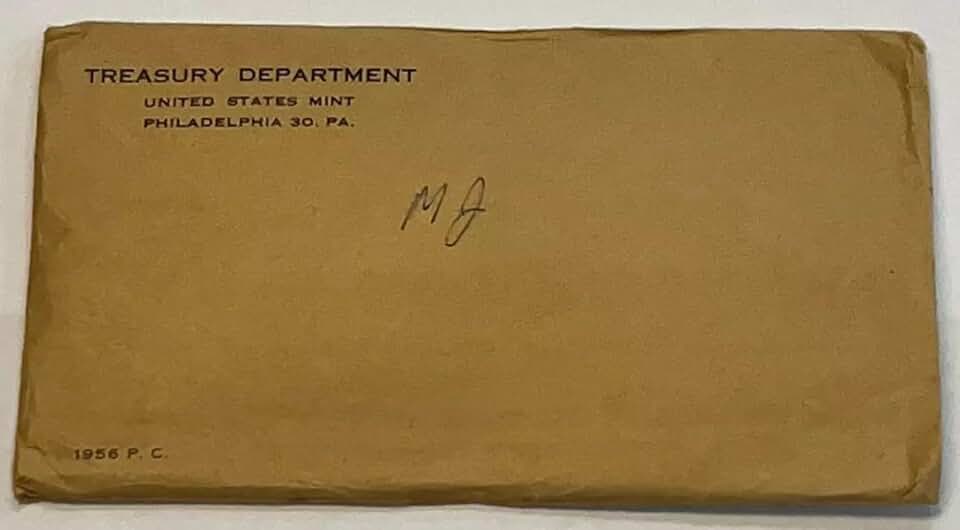
The original packaging, a sealed cellophane wrapper encased in a brown paper envelope from the Treasury Department, is crucial for maintaining the set’s integrity and value. This packaging protected the coins from environmental damage and handling, preserving their pristine proof condition for decades.
Collectors highly value sets that remain in their original, undisturbed envelopes, as this provides strong evidence of authenticity and original condition. The Philadelphia Mint, responsible for these sets, did not apply a mint mark to proof coins during this period, a common practice that continued for many years.
Understanding the historical context of 1956 adds another layer of appreciation to this set. It was a time of post-war prosperity and cultural shifts in America, and these coins circulated during significant events in the nation’s history. Owning a 1956 Mint Proof Set connects you directly to that vibrant era.
The inherent beauty of these proof coins, with their sharp strikes and brilliant surfaces, makes them not only historical artifacts but also works of art. Each denomination, from the humble cent to the majestic half dollar, exhibits the pinnacle of minting craftsmanship from the mid-century.
For many numismatists, collecting proof sets from specific years is a way to capture a snapshot of a particular moment in time. The 1956 set offers this opportunity with exceptional quality and a relatively robust supply, ensuring its place as a cornerstone in many collections.
The allure of the 1956 Mint Proof Set also lies in its potential as an investment. While coin values can fluctuate, well-preserved proof sets from reputable periods often retain and increase in value over time, especially those in their original, sealed state. This makes it an attractive option for both seasoned investors and hobbyists.
The consistent demand for these vintage proof sets among collectors underscores their enduring appeal. Whether you are a beginner looking for a foundational piece or an advanced collector seeking a high-quality example, the 1956 set offers significant value and historical depth.
1956 Mint Proof Set Key Features & Specifications
The intrinsic value and appeal of the 1956 Mint Proof Set are deeply rooted in its specific features and technical specifications, which highlight the U.S. Mint’s commitment to quality during that era. Understanding these details is essential for appreciating the set’s numismatic significance.
Each coin in the set was struck at the Philadelphia Mint. Notably, proof coins from Philadelphia during this period do not bear a mint mark, a characteristic that differentiates them from circulating coins produced in Denver or San Francisco when those mints were active in proof production.
The most defining characteristic of these coins is their proof quality. This refers to a specialized minting process where coin blanks (planchets) are highly polished, and dies are specially prepared and often polished or sandblasted to create contrasting finishes. The result is typically a mirror-like field and frosted, sharply detailed devices.
The set comprises five distinct denominations, each with its own metallic composition and design:
- Lincoln Cent (1C): Composed of 95% copper and 5% zinc, featuring Victor David Brenner’s iconic design of Abraham Lincoln on the obverse and the Lincoln Memorial on the reverse. The proof strike brings out exceptional detail in Lincoln’s bust and the memorial’s columns.
- Jefferson Nickel (5C): Made of 75% copper and 25% nickel. The obverse features Felix Schlag’s portrait of Thomas Jefferson, while the reverse depicts Monticello. The proof finish enhances the texture of Jefferson’s hair and the architectural lines of Monticello.
- Roosevelt Dime (10C): Struck in 90% silver and 10% copper, a precious metal composition that adds to its intrinsic value. The coin features John R. Sinnock’s design of Franklin D. Roosevelt on the obverse and a torch, olive branch, and oak branch on the reverse. The mirror fields and frosted devices are particularly striking on this smaller coin.
- Washington Quarter (25C): Also composed of 90% silver and 10% copper. The obverse displays John Flanagan’s bust of George Washington, with an eagle on the reverse. The proof strike accentuates the fine details in Washington’s wig and the eagle’s feathers.
- Franklin Half Dollar (50C): The largest coin in the set, made of 90% silver and 10% copper. Designed by John R. Sinnock, it features Benjamin Franklin on the obverse and the Liberty Bell with a small eagle on the reverse. This coin’s larger surface area beautifully showcases the proof finish, making it a highlight of the set.
The original Treasury Department sealed envelope is a critical feature. This packaging consists of a transparent cellophane wrapper holding the coins, which is then sealed inside a brown paper envelope. This original seal is paramount for verifying the set’s authenticity and its untouched condition, protecting the coins from environmental degradation and human contact.
Mintage figures for the 1956 Proof Set stand at 669,384 units. While seemingly high, the number of sets that have survived in pristine, unopened condition is significantly lower, increasing the rarity of top-grade examples. This contributes to the set’s collectibility and market value.
The overall condition of the coins within the set is expected to be exceptional, typically ranging from Proof-65 (PR-65) to Proof-68 (PR-68) or higher, assuming the set has been properly stored. Coins with imperfections like hairlines, spots, or toning can occur, even in sealed sets, due to various environmental factors over time.
For serious collectors, understanding the nuances of proof grading is vital. Terms like "Cameo" and "Deep Cameo" (DCAM) refer to the intensity of the contrast between the frosted devices and mirror fields. A DCAM designation significantly increases the value and desirability of a coin within the 1956 Mint Proof Set.
The intrinsic silver content of the dime, quarter, and half dollar also adds a layer of value, separating this set from modern proof sets made with clad coinage. This silver content provides a floor for the set’s value, independent of its numismatic appeal.
Pros & Cons of the 1956 Mint Proof Set
Like any significant collectible, the 1956 Mint Proof Set comes with a unique set of advantages and potential drawbacks. Weighing these factors is crucial for any potential buyer, whether they are a seasoned numismatist or a newcomer to coin collecting.
Pros of the 1956 Mint Proof Set:
- Exceptional Proof Quality and Aesthetic Appeal: The coins in this set exhibit superior craftsmanship, featuring mirror-like fields and sharply frosted devices. This striking visual contrast makes them incredibly beautiful to behold and a standout addition to any collection.
- Significant Historical Value: Owning a 1956 Mint Proof Set connects collectors to a specific period in American history. The coins reflect the designs and metallic compositions prevalent during the mid-20th century, offering a tangible link to the past.
- Original Treasury Department Sealed Envelope: The presence of the original sealed packaging is a major advantage. It authenticates the set’s origin and helps ensure the coins have been protected from mishandling and environmental damage, maintaining their pristine condition.
- Potential for Appreciation in Value: Well-preserved proof sets, especially those from the silver era, often demonstrate strong long-term investment potential. Their limited mintage and historical significance contribute to sustained demand among collectors, which can lead to value growth.
- Completeness of a Full Year’s Issue: The set offers a complete collection of all five denominations minted for that year. This provides a comprehensive snapshot of U.S. coinage for 1956, simplifying the collecting process for those who want a representative example.
- Educational Value: For those new to numismatics, studying a proof set like this can be an excellent way to learn about minting processes, coin designs, and historical context. It serves as a great educational tool for understanding American coinage.
- Relatively Accessible: Compared to much rarer proof sets from earlier decades, the 1956 set’s mintage figures make it more readily available to a broader range of collectors. This accessibility allows more people to experience the joy of owning a vintage proof set.
Cons of the 1956 Mint Proof Set:
- Higher Price Point: Due to its historical significance, proof quality, and silver content, the 1956 Mint Proof Set commands a higher price than circulated coin sets or modern clad proof sets. This can be a barrier for collectors on a strict budget.
- Limited Availability in Top Grades: While the overall mintage was considerable, finding sets that are still in perfect, untoned, and unblemished condition within their original sealed envelopes can be challenging. Many sets may have developed toning or minor imperfections over time.
- Risk of Mishandling if Removed from Original Packaging: If a collector decides to remove the coins from their original Treasury Department sealed envelope, there’s a significant risk of damaging the proof surfaces. Fingerprints, scratches, or exposure to air can quickly degrade the coins’ condition and value.
- Market Fluctuations: The value of collectible coins, including the 1956 Mint Proof Set, can be subject to market demand and economic conditions. While generally stable, periods of decreased interest or economic downturns could affect its immediate resale value.
- Authenticity Concerns (if not from reputable sources): While the sealed envelope helps, buyers must still be cautious about purchasing from unknown sources. Ensuring the set is genuinely from 1956 and in its original, untampered packaging requires dealing with reputable dealers or platforms.
Careful consideration of these pros and cons will help collectors make an informed decision about acquiring the 1956 Mint Proof Set. Its beauty and historical weight often outweigh the challenges for dedicated enthusiasts.
Who Should Buy the 1956 Mint Proof Set?
The 1956 Mint Proof Set appeals to a diverse range of individuals, each with unique motivations for adding this historical treasure to their possession. Understanding who benefits most from this set can help potential buyers determine if it’s the right choice for their collection or investment strategy.
Serious Numismatists and Advanced Collectors: This set is an ideal acquisition for those who are building comprehensive collections of U.S. proof sets or seeking high-grade examples from the mid-20th century. Its pristine condition and historical significance make it a cornerstone piece for such endeavors.
History Enthusiasts and American Memorabilia Collectors: Anyone with a keen interest in American history, particularly the post-World War II era, will find immense value in this set. It serves as a tangible artifact from 1956, reflecting the coinage that was current during that pivotal time.
Investors Looking for Tangible Assets: The silver content in the dime, quarter, and half dollar, combined with the numismatic premium, makes the 1956 Mint Proof Set an attractive option for investors. It offers a hedge against inflation and a tangible asset that can appreciate over time, unlike many paper investments.
Individuals Seeking Unique and Memorable Gifts: For milestone birthdays (especially for someone born in 1956), graduations, or anniversaries, a vintage proof set makes an incredibly thoughtful and lasting gift. It’s a personal touch that connects the recipient to a specific year and offers both aesthetic beauty and historical depth.
Collectors of U.S. Type Sets: For those assembling a "type set" of U.S. coinage, which aims to collect one example of each coin design, the proof quality of the 1956 set provides an excellent, high-quality representation of the Lincoln Cent, Jefferson Nickel, Roosevelt Dime, Washington Quarter, and Franklin Half Dollar designs.
Beginner Collectors with an Eye for Quality: While the price point might be higher than entry-level circulated coins, a beginner who wants to start their collection with a significant, high-quality piece will find the 1956 Mint Proof Set to be a rewarding choice. It sets a high standard for future acquisitions.
Those Who Appreciate Art and Craftsmanship: Beyond its monetary and historical value, the set is a testament to the artistry of coin design and the precision of minting. The intricate details and mirror-like surfaces appeal to anyone who values fine craftsmanship and aesthetic beauty.
Heirloom Seekers: Many purchase such sets with the intention of passing them down through generations. A 1956 proof set can become a cherished family heirloom, carrying historical significance and potential value for future family members.
Ultimately, the 1956 Mint Proof Set is for anyone who values history, art, and the tangible preservation of American heritage. It’s a purchase that goes beyond mere currency, offering a rich experience for collectors across various interests and levels of expertise.
The enduring appeal of the 1956 Mint Proof Set lies in its ability to satisfy both the intellectual curiosity of the historian and the aesthetic appreciation of the art lover. It represents a unique intersection of numismatic excellence and cultural artifact, making it a versatile and valuable addition to many different types of collections.
Before making a purchase, prospective buyers should always consider their budget, their collecting goals, and the specific condition of the set they are considering. Researching reputable dealers and understanding grading standards will ensure a satisfying acquisition of this magnificent proof set.
Whether you’re looking to complete a series, invest in a tangible asset, or simply own a beautiful piece of history, the 1956 Mint Proof Set offers a compelling proposition. Its blend of rarity, quality, and historical context makes it a standout choice in the world of coin collecting.
For those new to collecting, this set can serve as an inspiring entry point into the hobby, showcasing the highest standards of minting. For seasoned collectors, it represents a solid and respected addition to their existing treasures. The decision to acquire this set is often driven by a passion for numismatics.
FAQ about the 1956 Mint Proof Set
Navigating the world of numismatics can sometimes be complex, especially when dealing with vintage sets like the 1956 Mint Proof Set. Here are answers to some frequently asked questions to provide clarity and assist collectors.
Q1: What is a proof set, and how is it different from regular coins?
A proof set consists of coins specially struck for collectors, not for circulation. Unlike regular "business strike" coins, proof coins are produced using highly polished planchets (coin blanks) and specially prepared dies, often struck multiple times. This process results in a distinct mirror-like finish on the fields and frosted, sharply detailed devices, giving them a superior aesthetic quality compared to everyday coinage. Proof coins are handled with extreme care during production to prevent imperfections.
Q2: What coins are included in the 1956 Mint Proof Set?
The 1956 Mint Proof Set includes one example of each circulating denomination issued by the U.S. Mint in 1956. These are the Lincoln Cent (1 cent), Jefferson Nickel (5 cents), Roosevelt Dime (10 cents), Washington Quarter (25 cents), and Franklin Half Dollar (50 cents). All five coins are housed together in their original protective packaging.
Q3: Why is the original Treasury Department sealed envelope important?
Preservation of the original Treasury Department sealed envelope is paramount for the 1956 Mint Proof Set. This packaging serves multiple critical functions: it authenticates the set as a genuine product from the U.S. Mint, protects the delicate proof surfaces from environmental damage and handling, and significantly enhances the set’s collector value. An unopened, original envelope confirms the coins have likely remained in their pristine state since minting.
Q4: How can I determine the condition and value of my 1956 Mint Proof Set?
Determining the condition and value involves several factors. The first is the integrity of the original sealed envelope; an intact seal is crucial. Next, examine the coins for any signs of toning, hazing, or spotting, as well as scratches or hairlines. Professional grading by services like PCGS or NGC can provide an objective assessment and assign a numerical grade (e.g., PR-67, PR-68), which heavily influences value. Consulting current price guides and auction results for similar graded sets is also essential.
Q5: Is the 1956 Mint Proof Set a good investment?
For many, the 1956 Mint Proof Set is considered a sound numismatic investment. Its silver content provides intrinsic value, while its historical significance, limited mintage, and high demand among collectors contribute to its potential for appreciation. Like all investments, coin values can fluctuate, but well-preserved proof sets from this era often perform well over the long term, especially those in top "Cameo" or "Deep Cameo" conditions. It’s often recommended as part of a diversified portfolio of collectibles.
Q6: Are there any common varieties or errors in the 1956 set?
While major errors or varieties are less common in proof sets due to the meticulous production process, minor die variations can sometimes occur. For the 1956 set specifically, there are no widely recognized, highly sought-after varieties or errors that significantly impact value across the board. Collectors generally focus on the overall strike quality and preservation of the proof surfaces rather than specific error hunting for this particular year.
Q7: Where was the 1956 Mint Proof Set produced?
All coins within the 1956 Mint Proof Set were produced at the United States Mint facility in Philadelphia, Pennsylvania. During this era, proof sets struck at the Philadelphia Mint did not carry a mint mark, which is a key characteristic to remember when identifying these coins. The Philadelphia Mint has a long and storied history of producing some of the nation’s finest coinage.
Q8: How should I store and preserve my 1956 Mint Proof Set?
Proper storage is critical for preserving the value and condition of your 1956 Mint Proof Set. Ideally, keep the set in its original Treasury Department sealed envelope. Store it in a cool, dry, and stable environment, away from direct sunlight, extreme temperature fluctuations, and high humidity, which can cause toning or spotting.
Archival-safe plastic holders or albums designed for proof sets can offer additional protection while allowing for viewing without direct handling of the coins. Never open the original sealed envelope unless you plan to have the coins professionally graded and encapsulated.
Final Verdict
The 1956 Mint Proof Set represents a remarkable confluence of historical significance, numismatic artistry, and investment potential, making it an outstanding acquisition for a wide array of collectors. Its pristine proof quality, featuring mirror-like fields and frosted devices, stands as a testament to the U.S. Mint’s commitment to excellence during the mid-20th century. Each coin in the set—the Lincoln Cent, Jefferson Nickel, Roosevelt Dime, Washington Quarter, and Franklin Half Dollar—is a miniature work of art, perfectly preserved.
The inclusion of three silver coins (dime, quarter, and half dollar) adds intrinsic value, providing a solid foundation for its worth beyond mere collector demand. This silver content, combined with the set’s historical context and limited mintage of 669,384 units, ensures its enduring appeal and potential for long-term appreciation. The original Treasury Department sealed envelope is a crucial factor, confirming authenticity and protecting the coins from environmental degradation.
While the price point may be higher than circulated sets, the value offered by the 1956 Mint Proof Set far outweighs this consideration for serious collectors and investors. It provides a complete, high-quality snapshot of American coinage from a specific year, serving as both a beautiful display piece and a tangible asset. Its accessibility, compared to much rarer earlier proof sets, makes it an excellent entry point for new collectors seeking quality.
For those passionate about American history, fine craftsmanship, or building a robust numismatic portfolio, this set is an essential addition. It serves as an excellent gift for a special occasion, a foundational piece for a growing collection, or a secure investment that can be passed down through generations. The educational value it provides in understanding minting processes and coin designs is also invaluable.
In conclusion, the 1956 Mint Proof Set is more than just a collection of coins; it’s a piece of preserved history, a work of art, and a smart investment. Its combination of aesthetic appeal, historical weight, and potential for financial growth makes it a highly recommended purchase. This set truly offers excellent value for anyone looking to enrich their collection or invest in a tangible piece of the past.
For more information on U.S. Mint products, visit the official U.S. Mint website. To delve deeper into the history of proof sets, consult resources like Wikipedia’s page on United States Proof Sets.