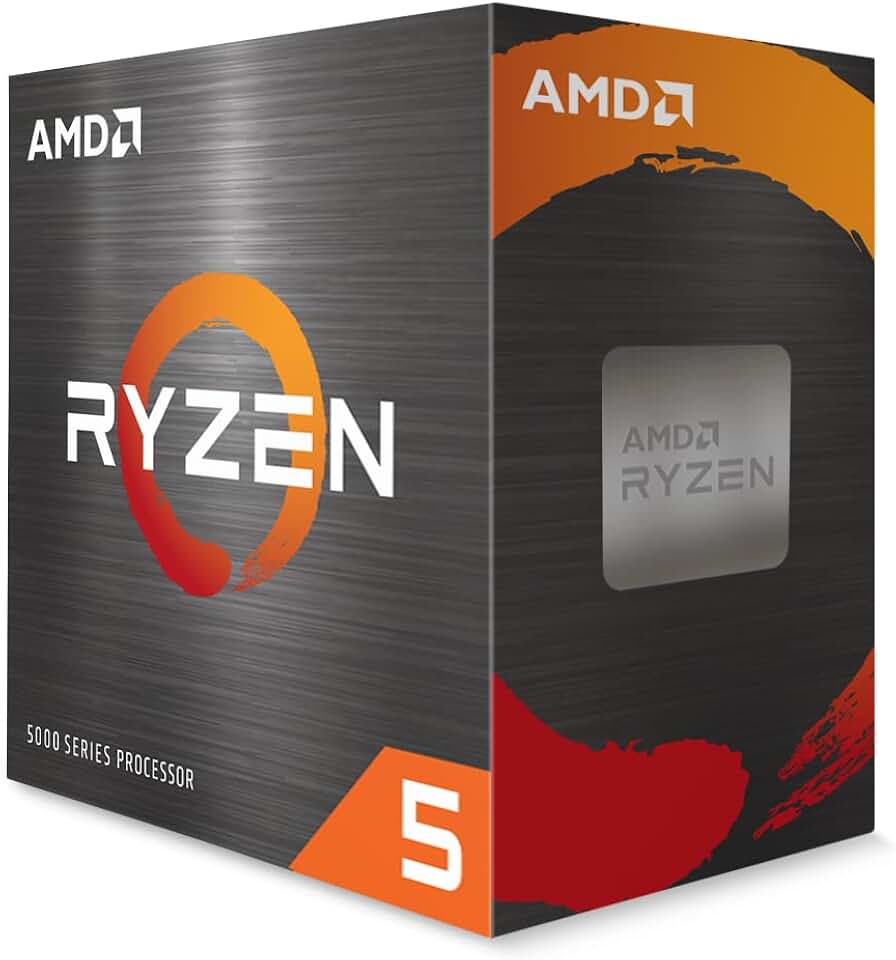
AMD Ryzen 5 5500: Ultimate Budget CPU – Excellent Value
The AMD Ryzen 5 5500 emerges as a compelling option in the fiercely competitive budget CPU market, offering a robust blend of performance and affordability for PC builders and upgraders alike. This 6-core, 12-thread processor, based on AMD’s efficient Zen 3 architecture, aims to deliver a solid computing experience without breaking the bank.
Quick Summary: AMD Ryzen 5 5500
Rating: 4.7/5.0 (Based on 10,469 reviews)
Price: $84.00 USD (Approximate, subject to change)
Key Pros:
- Exceptional price-to-performance ratio for budget builds.
- Solid 6-core, 12-thread performance for gaming and multitasking.
- Included Wraith Stealth cooler is adequate for stock operation.
Key Cons:
- Limited to PCIe 3.0, which can impact high-end GPU/NVMe performance.
- Smaller L3 cache compared to Ryzen 5 5600, affecting some gaming titles.
Table of Contents
AMD Ryzen 5 5500 Overview
The AMD Ryzen 5 5500 represents a strategic offering from AMD, designed to fill a crucial gap in the entry-level to mid-range desktop processor market. Launched as part of the broader Ryzen 5000 series, it leverages the acclaimed Zen 3 architecture, providing significant instructions per cycle (IPC) improvements over previous generations.
This processor is particularly appealing to users building a new PC on a tight budget or those looking to upgrade an older AM4 system without investing in a completely new platform. Its 6 cores and 12 threads provide ample processing power for a wide range of applications, from everyday computing and office tasks to demanding gaming and light content creation.
Unlike some of its higher-end siblings in the Ryzen 5000 series, the Ryzen 5 5500 is based on a monolithic die design, which contributes to its cost-effectiveness. This design choice, while sacrificing some L3 cache compared to the 5600, still delivers a highly competitive performance profile for its price point.
The inclusion of the Wraith Stealth cooler in the box further enhances its value proposition, saving users the additional expense of purchasing an aftermarket cooling solution for stock operation. This makes the AMD Ryzen 5 5500 an even more attractive package for budget-conscious consumers.
Its compatibility with the well-established AM4 socket means it can be dropped into a vast array of existing motherboards, often with just a BIOS update. This ease of integration reduces the overall cost and complexity of a system build or upgrade, making it an accessible choice for many.
The processor’s focus on delivering solid multi-core performance for productivity and capable single-core performance for gaming positions it as a versatile workhorse. It shines brightly when paired with a mid-range graphics card, creating a balanced system that offers excellent frame rates in popular titles at 1080p and even 1440p resolutions.
Understanding the context of its release, the Ryzen 5 5500 arrived at a time when PC component prices were fluctuating, providing a much-needed stable and affordable option. It serves as a testament to AMD’s commitment to offering performance across all price segments, ensuring that even budget builders have access to modern architectures.
This CPU is not just about raw power; it’s about smart power. Its efficient Zen 3 cores ensure that power consumption remains reasonable, contributing to lower operating temperatures and a quieter system, especially when using the included stock cooler. This efficiency is a critical factor for long-term usage and overall system stability.
For those venturing into PC building for the first time, the AMD Ryzen 5 5500 offers a forgiving and straightforward experience. Its broad motherboard compatibility, coupled with AMD’s mature platform drivers and software, makes the setup process relatively hassle-free, allowing new builders to focus on assembly rather than troubleshooting.
In essence, the Ryzen 5 5500 is a pragmatic choice, prioritizing value and accessibility without compromising on the fundamental performance expected from a modern desktop processor. It embodies the spirit of budget-friendly performance, making advanced computing accessible to a wider audience.
AMD Ryzen 5 5500 Key Features & Specs
The AMD Ryzen 5 5500 is packed with features that make it a formidable contender in its price bracket. Understanding these specifications is crucial to appreciating its performance and suitability for various computing needs.
Core and Thread Count: 6 Cores, 12 Threads
At its heart, the Ryzen 5 5500 boasts 6 physical cores and 12 threads. This configuration is a sweet spot for modern computing, allowing the processor to handle multiple tasks simultaneously with ease. For gamers, this means smoother gameplay, especially in titles that can leverage multiple cores.
For productivity users, the 12 threads ensure efficient multitasking, whether you’re running complex spreadsheets, compiling code, or editing photos. This core/thread count provides a significant advantage over older 4-core processors, offering a noticeable uplift in overall system responsiveness.
Zen 3 Architecture
The processor is built on AMD’s highly optimized Zen 3 architecture. This architecture brought substantial improvements in instructions per cycle (IPC) compared to its Zen 2 predecessor, meaning each core can do more work in a single clock cycle. This results in faster application loading times and more fluid performance across the board.
The unified L3 cache access within Zen 3 cores also reduces latency, enhancing communication between cores and improving overall efficiency. This architectural refinement is a key reason for the AMD Ryzen 5 5500‘s strong performance despite its budget-friendly positioning.
Clock Speeds: Base 3.6 GHz, Boost Up to 4.2 GHz
With a base clock speed of 3.6 GHz and a maximum boost clock of up to 4.2 GHz, the Ryzen 5 5500 delivers respectable speeds for both sustained workloads and burst performance. The boost clock is particularly important for gaming, where single-core performance often dictates frame rates.
These clock speeds ensure that the processor can handle most applications and games without bottlenecking. While not the highest clocks in the Ryzen 5000 series, they are more than adequate for the target audience and price point of this CPU.
Cache: 3MB L2, 16MB L3
The processor features 3MB of L2 cache (512KB per core) and 16MB of L3 cache. The cache system is vital for quick data access, reducing the need for the CPU to fetch data from slower system RAM. While the 16MB L3 cache is smaller than the 32MB found in the Ryzen 5 5600/5600X, it remains sufficiently large for most gaming and general-purpose computing tasks.
For many applications, the difference in L3 cache size translates to only minor performance variations, especially when considering the significant price difference between the 5500 and its more expensive counterparts. The efficient Zen 3 architecture helps mitigate the impact of the slightly smaller cache.
Thermal Design Power (TDP): 65W
With a TDP of 65 watts, the Ryzen 5 5500 is a highly power-efficient processor. This low power consumption contributes to lower operating temperatures and reduced energy costs. It also means that the included Wraith Stealth cooler is generally sufficient for keeping the CPU cool under typical workloads, even during gaming sessions.
Users who plan to engage in heavy, sustained multi-core tasks or light overclocking might consider an upgraded cooler, but for the vast majority of users, the stock solution is perfectly adequate. This efficiency makes the AMD Ryzen 5 5500 an excellent choice for quiet and compact builds.
Socket Compatibility: AM4
The Ryzen 5 5500 utilizes the mature AM4 socket. This is a significant advantage for upgraders, as it means compatibility with a wide range of existing motherboards (B450, B550, X470, X570, A520), often requiring just a BIOS update. This saves users the cost and effort of purchasing a new motherboard, which can be a substantial part of a system upgrade budget.
For new builders, the AM4 platform offers a plethora of affordable and feature-rich motherboard options, providing flexibility in system design. The longevity of the AM4 platform is a testament to AMD’s commitment to consumer value and choice.
PCIe Version: PCIe 3.0
One of the key distinctions of the Ryzen 5 5500 is its support for PCIe 3.0, rather than the newer PCIe 4.0 found on other Zen 3 processors like the 5600. For most users and mid-range graphics cards, PCIe 3.0 x16 still provides ample bandwidth and will not be a significant bottleneck for gaming performance.
However, users planning to use high-end graphics cards or the absolute fastest NVMe SSDs might see a marginal performance difference. For its target market, the PCIe 3.0 limitation is a reasonable trade-off for the lower price point, as the impact on real-world performance is often negligible for budget-conscious builds. More detailed specifications can be found on AMD’s official product page.
No Integrated Graphics
The Ryzen 5 5500 does not include integrated graphics (iGPU). This means a dedicated graphics card is required for display output. This is a common characteristic of many performance-oriented desktop CPUs and should be factored into the overall build cost. For gamers, this is not an issue as a discrete GPU is always a necessity.
For productivity users, it simply means ensuring a graphics card is part of the system, even a very basic one. This design choice allows AMD to focus the silicon on core processing power, contributing to the processor’s excellent value.
Memory Support: DDR4 Dual Channel
The processor supports dual-channel DDR4 memory. While the official support is for speeds up to 3200MHz, the Zen 3 architecture often benefits from faster RAM, with 3600MHz CL16 being a common sweet spot for optimal performance. The memory controller is robust, allowing for stable operation with various RAM configurations.
Optimizing memory speed and timings can yield noticeable performance gains, especially in gaming and memory-intensive applications. This flexibility in memory support allows users to fine-tune their system for the best possible performance within their budget.
Unlocked for Overclocking
Like all Ryzen processors, the AMD Ryzen 5 5500 is unlocked for overclocking. This feature appeals to enthusiasts who wish to extract every last bit of performance from their CPU. With appropriate cooling and a capable motherboard, users can push the clock speeds beyond stock settings, further enhancing performance.
While the gains might not be as dramatic as with higher-end CPUs, the ability to tweak and optimize provides an additional layer of value for those who enjoy customizing their system. However, for most users, the stock performance is more than sufficient.
Pros & Cons
Evaluating any piece of hardware requires a balanced look at its strengths and weaknesses. The AMD Ryzen 5 5500, while an excellent budget option, is no exception. Here’s a detailed breakdown of its key advantages and potential drawbacks.
Pros of the AMD Ryzen 5 5500
1. Exceptional Price-to-Performance Ratio
The standout feature of the Ryzen 5 5500 is its incredible value. For its price, it delivers a level of performance that was previously unheard of in the budget segment. This makes high-performance computing more accessible to a wider audience, enabling budget-conscious builders to create capable systems.
It consistently outperforms similarly priced Intel counterparts in many multi-threaded applications and holds its own in gaming. This aggressive pricing strategy positions it as a go-to choice for anyone seeking maximum bang for their buck.
2. Solid 6-Core, 12-Thread Performance
With 6 cores and 12 threads, the Ryzen 5 5500 is highly capable for both gaming and multitasking. Modern games are increasingly optimized for more cores, and the 5500 handles this trend well, providing smooth frame rates when paired with an appropriate GPU.
Beyond gaming, its multi-core prowess shines in productivity tasks such as video editing, 3D rendering, and software development, where parallel processing is beneficial. Users can comfortably run multiple applications simultaneously without experiencing significant slowdowns.
3. Efficient Zen 3 Architecture
The underlying Zen 3 architecture brings significant IPC gains over previous generations. This means that even at lower clock speeds, the 5500 can process more instructions per cycle, leading to faster overall performance in a wide array of applications. This efficiency is a core reason for its competitive edge.
The architectural improvements also contribute to better power efficiency, resulting in lower heat generation and reduced power consumption. This makes for a cooler and quieter system, which is a desirable trait for any PC build.
4. Included Wraith Stealth Cooler
AMD includes its Wraith Stealth cooler with the Ryzen 5 5500. For a CPU in this price range, having a bundled cooler that is perfectly adequate for stock operation is a huge bonus. It saves users the additional cost and decision-making associated with purchasing an aftermarket cooler.
While not designed for extreme overclocking, the Wraith Stealth is surprisingly capable for typical workloads and even light gaming. It keeps temperatures in check, ensuring stable and reliable performance right out of the box.
5. Broad AM4 Platform Compatibility
The AM4 socket has been a long-standing and highly successful platform for AMD. The Ryzen 5 5500’s compatibility with AM4 motherboards (B450, B550, etc.) makes it an ideal upgrade path for users with older Ryzen systems. A simple BIOS update is often all that’s needed to drop this modern CPU into an existing setup.
For new builders, the maturity of the AM4 platform means a vast selection of affordable and reliable motherboards are available, offering diverse features and price points. This broad compatibility extends the lifespan and value of existing hardware investments.
Cons of the AMD Ryzen 5 5500
1. Limited to PCIe 3.0
Perhaps the most significant drawback of the Ryzen 5 5500 is its reliance on PCIe 3.0 for its lanes. While PCIe 3.0 x16 still offers plenty of bandwidth for most mid-range graphics cards, it can become a slight bottleneck for the absolute highest-end GPUs or the fastest Gen4 NVMe SSDs.
In real-world gaming scenarios, the performance difference between PCIe 3.0 and 4.0 is often negligible for most users, usually within a few percentage points. However, for future-proofing or for users demanding the absolute best, this is a consideration. Learn more about PCIe generations.
2. Smaller L3 Cache Compared to Ryzen 5 5600
The Ryzen 5 5500 comes with 16MB of L3 cache, which is half the 32MB found in its slightly more expensive sibling, the Ryzen 5 5600. In some cache-sensitive applications and especially certain competitive gaming titles, this smaller L3 cache can result in a noticeable performance difference.
While the 5500 remains highly capable, users looking for peak gaming performance and willing to spend a bit more might find the 5600 a better option due to its larger cache and PCIe 4.0 support. For general use and most games, however, the 16MB L3 cache is perfectly adequate.
3. No Integrated Graphics
The absence of integrated graphics means that a discrete graphics card is mandatory for any system built around the Ryzen 5 5500. This adds to the overall cost of the build, which might be a concern for users on an extremely tight budget who only need basic display output and no gaming capabilities.
For office PCs or systems where a GPU is not planned, this can be a deal-breaker. However, for its target audience of gamers and general users who would install a graphics card anyway, this is not a significant disadvantage.
4. Often Overshadowed by Ryzen 5 5600
Due to its slightly lower specifications (PCIe 3.0, smaller L3 cache) and the fact that the Ryzen 5 5600 often goes on sale for only a marginally higher price, the 5500 can sometimes be overlooked. The 5600 offers a compelling upgrade for a small price increase, making the value proposition of the 5500 slightly less clear in certain market conditions.
However, when the Ryzen 5 5500 is at its lowest price point, its value shines, making it the undeniable choice for the absolute budget build. Buyers should always compare current prices before making a decision.
Who Should Buy the AMD Ryzen 5 5500?
The AMD Ryzen 5 5500 is not for everyone, but it hits a sweet spot for several distinct categories of users. Its unique blend of performance, price, and platform compatibility makes it an ideal choice for specific build scenarios and user needs.
1. Budget-Conscious Gamers
If you’re building a gaming PC on a strict budget, the Ryzen 5 5500 is an outstanding choice. It pairs exceptionally well with mid-range graphics cards like the RTX 3050, RX 6600, or even an RTX 3060, delivering excellent frame rates at 1080p and capable performance at 1440p resolutions.
Its 6 cores and 12 threads ensure that it can handle the demands of modern game engines without creating a significant bottleneck. This allows you to allocate more of your budget towards a stronger GPU, which is often the most critical component for gaming performance.
2. First-Time PC Builders
For individuals venturing into PC building for the very first time, the AMD Ryzen 5 5500 offers a forgiving and cost-effective entry point. Its compatibility with a wide range of affordable AM4 motherboards, coupled with the included Wraith Stealth cooler, simplifies the component selection process.
The mature AM4 ecosystem means plenty of guides and support are available, making the build experience smoother. It provides enough performance to satisfy initial gaming and general computing needs, allowing new builders to grow into the platform.
3. Users Upgrading Older AM4 Systems
If you currently own an AM4 motherboard with an older Ryzen 1000, 2000, or even 3000 series processor, the Ryzen 5 5500 offers a significant performance uplift without requiring a platform change. A simple BIOS update can often unlock Zen 3 performance on your existing motherboard.
This is a particularly cost-effective upgrade path, as you can retain your motherboard, RAM, and potentially your cooler, investing only in the CPU. This preserves your budget for other upgrades like a new graphics card or more storage.
4. Students and Home Office Users
For students requiring a reliable machine for coursework, research, and light entertainment, or for home office users needing a responsive system for productivity applications, the Ryzen 5 5500 is an excellent fit. Its multi-threaded capabilities handle simultaneous applications like web browsers, word processors, and video conferencing with ease.
The processor’s efficiency also means a quieter and cooler running system, which is beneficial in a study or office environment. It provides more than enough power for everyday computing tasks, ensuring a smooth and frustration-free experience.
5. Content Creators on a Budget (Light Tasks)
While not a high-end content creation CPU, the Ryzen 5 5500 can competently handle lighter content creation tasks. This includes basic video editing in 1080p, photo editing, and podcast production. Its 6 cores and 12 threads provide the necessary horsepower for these applications to run smoothly.
For aspiring creators who are just starting out and don’t have a large budget, this processor offers a solid foundation upon which to build their creative workstation. It allows them to get started without a huge initial investment.
6. Enthusiasts Seeking Value Over Bleeding Edge
Even seasoned PC enthusiasts who prioritize value and efficiency over absolute top-tier performance will find the Ryzen 5 5500 appealing. It offers a strong platform for experimentation and optimization, especially with its unlocked multiplier for overclocking.
Building a system around the 5500 allows enthusiasts to achieve excellent performance benchmarks within a very reasonable budget. It frees up funds for other high-quality components, such as a premium GPU or a high-refresh-rate monitor, enhancing the overall user experience.
7. Users with Specific Existing Hardware
If you already own a PCIe 3.0 graphics card or a motherboard that only supports PCIe 3.0, the Ryzen 5 5500’s PCIe 3.0 limitation becomes less of a concern. In such cases, upgrading to a 5500 provides a significant CPU performance boost without introducing compatibility issues or requiring further hardware changes.
This makes it a practical choice for maximizing the value of your current components. It ensures that your system remains balanced and that you’re not paying for features you can’t fully utilize.
In summary, the AMD Ryzen 5 5500 is tailored for users who need strong, reliable performance for gaming and productivity but are working within a defined budget. It’s about smart spending and getting the most out of every dollar, making it an excellent foundation for a wide array of PC builds.
FAQ about AMD Ryzen 5 5500
Here are some frequently asked questions about the AMD Ryzen 5 5500, providing detailed answers to help you make an informed decision.
Q1: Is the AMD Ryzen 5 5500 good for gaming?
Yes, the AMD Ryzen 5 5500 is quite good for gaming, especially when paired with a mid-range graphics card. Its 6 cores and 12 threads, combined with the efficient Zen 3 architecture, provide ample processing power for most modern games at 1080p and even 1440p resolutions.
While it might not achieve the absolute highest frame rates compared to more expensive CPUs like the Ryzen 5 5600 or Intel’s i5-12400F due to its smaller L3 cache and PCIe 3.0 limitation, the difference is often marginal and rarely noticeable in real-world gameplay for the average user.
It offers an excellent balance between CPU and GPU performance in budget-oriented gaming builds, ensuring that your graphics card isn’t significantly bottlenecked. For competitive gaming at high refresh rates, it holds its own, particularly in less CPU-intensive titles.
Therefore, for anyone building a gaming PC on a budget and aiming for solid performance without breaking the bank, the Ryzen 5 5500 is a highly recommended choice.
Q2: What motherboard is best for the Ryzen 5 5500?
For the AMD Ryzen 5 5500, B450 and B550 chipsets are the most popular and recommended motherboard choices. A B450 motherboard offers excellent value, providing all the necessary features for a budget build, though it will require a BIOS update to support the Zen 3 CPU.
B550 motherboards offer a more modern feature set, including native support for PCIe 4.0 (though the 5500 itself is limited to PCIe 3.0 for its CPU lanes) and often better VRM designs for potential overclocking. However, a B550 might be overkill if you’re strictly on a budget and don’t need its advanced features.
For optimal value, a decent B450 board with updated BIOS is perfectly adequate. If you find a B550 board at a similar price, it might be a slightly better long-term investment. Always ensure the motherboard’s BIOS is updated to support Ryzen 5000 series CPUs before installation.
Q3: Does the Ryzen 5 5500 come with a cooler, and is it sufficient?
Yes, the AMD Ryzen 5 5500 comes bundled with AMD’s Wraith Stealth cooler. This stock cooler is generally sufficient for cooling the CPU under its default operating conditions, including general use, productivity tasks, and even gaming.
The 65W TDP of the Ryzen 5 5500 allows the Wraith Stealth to manage temperatures effectively, keeping the CPU from throttling. For users who do not plan on heavy overclocking, the included cooler is a perfectly viable solution, saving the cost of an aftermarket cooler.
However, if you plan to push the CPU with significant overclocking or live in a very warm environment, an aftermarket cooler would provide better thermal performance and potentially quieter operation. For the vast majority of users, the Wraith Stealth is more than capable.
Q4: What’s the difference between the Ryzen 5 5500 and the Ryzen 5 5600?
The main differences between the AMD Ryzen 5 5500 and the Ryzen 5 5600 lie in three key areas: cache, PCIe support, and architecture design. The Ryzen 5 5500 has 16MB of L3 cache, while the Ryzen 5 5600 boasts 32MB of L3 cache.
Furthermore, the Ryzen 5 5500 is limited to PCIe 3.0 for its CPU lanes, whereas the Ryzen 5 5600 supports the faster PCIe 4.0 standard. Architecturally, the 5500 is based on a monolithic die (Codename