Complete Guide: Onyx M-16 Inflatable Belt — Full Verdict
The Onyx M-16 Inflatable Belt is a revolutionary personal flotation device (PFD) designed for those who value both safety and freedom of movement on the water. Unlike traditional bulky life vests, this compact belt pack offers a discreet yet highly effective solution for staying safe during various water activities.

Its low-profile design ensures that it won’t interfere with your casting, paddling, or sailing, making it a preferred choice for anglers, stand-up paddleboarders, kayakers, and casual boaters alike. This review will delve deep into its features, performance, and overall value, helping you decide if it’s the right safety gear for your aquatic adventures.
Quick Summary: Onyx M-16 Inflatable Belt
- Rating: 4.7 out of 5 stars (2607 reviews)
- Price: $101.35 USD
- Key Pros:
- Unrivaled Comfort: Extremely low-profile and lightweight, allowing for full range of motion without hindrance.
- USCG Approved: Meets stringent U.S. Coast Guard requirements for Type V PFDs when worn, providing peace of mind.
- Manual Activation: User-controlled inflation prevents accidental deployment, ideal for active water sports.
- Key Cons:
- Manual Only: Requires conscious effort to pull the cord for inflation, not suitable for unconscious users.
- Rearming Kits: Requires purchasing rearming kits after each deployment, adding to long-term cost.
Table of Contents
Onyx M-16 Inflatable Belt Overview
The Onyx M-16 Inflatable Belt represents a modern approach to personal safety on the water. It’s designed for individuals aged 16 and older, weighing over 80 pounds, and is a U.S. Coast Guard Approved Type V PFD with Type III performance. This classification means it provides the buoyancy of a Type III vest but must be worn to be counted as a PFD.
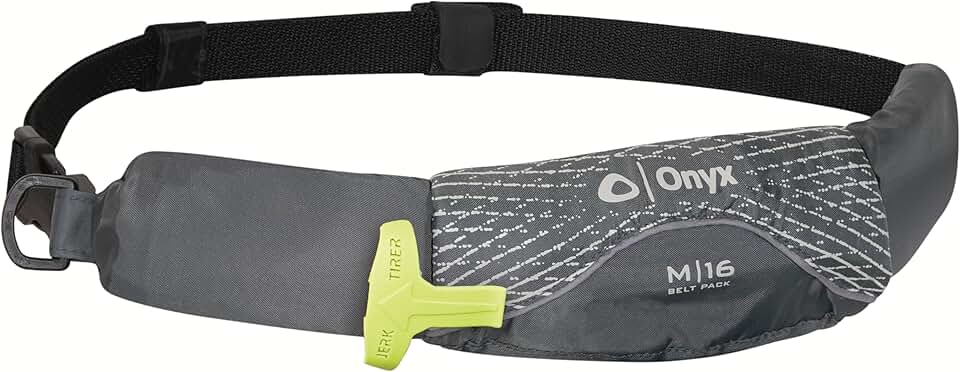
Its primary appeal lies in its minimalist design. Instead of a bulky vest, the M-16 is a small pouch worn around the waist, offering unparalleled comfort and freedom of movement. This makes it particularly popular among active water enthusiasts who find traditional life vests restrictive for activities like fishing, paddleboarding, or kayaking.
The manual inflation mechanism requires the user to pull a cord, which punctures a CO2 cartridge and rapidly inflates a bladder that can then be placed over the head. This deliberate action ensures that the PFD only deploys when truly needed, preventing accidental inflation that could occur with automatic models in wet conditions or during vigorous activities.
This design choice is crucial for users who might encounter splashes or light rain but don’t require constant buoyancy. It gives the wearer full control over when and how the PFD is activated. The bladder provides 17 lbs of buoyancy when inflated, which is comparable to many traditional foam life vests, offering reliable support in the water.
The M-16 is constructed with durable fabrics designed to withstand the rigors of marine environments. Its compact nature also makes it easy to store, whether in a small boat compartment, a kayak, or a backpack. This convenience encourages more people to carry a PFD, enhancing overall safety on the water.
Understanding the specific requirements and benefits of a manual inflatable PFD like the Onyx M-16 is essential for potential buyers. It’s not a ‘wear it and forget it’ device in the same way a foam vest might be, as it requires conscious action to deploy. However, for those who prioritize unencumbered movement, this trade-off is often well worth it.
This belt pack is an excellent example of how safety gear can evolve to meet the changing needs of outdoor enthusiasts. It addresses the common complaint of discomfort and bulkiness associated with older PFD designs, making water safety more accessible and less intrusive for a wide range of activities.
The thoughtful engineering behind the Onyx M-16 Inflatable Belt ensures that while it is unobtrusive, it does not compromise on safety. Its robust construction and reliable inflation system offer confidence to users, knowing that effective buoyancy is just a pull away. This balance of comfort and security is what sets it apart in the crowded PFD market.
Furthermore, the discreet nature of the M-16 means users are more likely to wear it consistently, which is arguably the most important aspect of any safety device. A PFD that is comfortable and doesn’t hinder movement is a PFD that will actually be worn, significantly increasing safety margins on the water. This commitment to user comfort directly translates to improved safety compliance.
For more information on USCG PFD types and requirements, you can visit the official U.S. Coast Guard Boating Safety Division website.
Onyx M-16 Inflatable Belt Key Features & Specs
The Onyx M-16 Inflatable Belt is packed with features that prioritize user comfort, reliability, and ease of use. Understanding these key specifications helps in appreciating its design and suitability for various water activities.
USCG Approval and Buoyancy
One of its most critical features is its U.S. Coast Guard Approval as a Type V PFD with Type III performance. This means it offers the same 17 lbs of buoyancy as a traditional Type III vest, ensuring adequate floatation for an adult. The Type V classification emphasizes that it must be worn to be considered an approved PFD.
Manual Inflation System
The M-16 operates via a manual inflation system. This involves a CO2 cylinder and a pull-cord mechanism. When the cord is pulled, a pin punctures the CO2 cartridge, instantly inflating the internal air bladder. This manual control is perfect for situations where accidental inflation could be an issue, such as in rough conditions or during active sports.
Compact and Low-Profile Design
Perhaps the most celebrated feature is its incredibly compact and low-profile design. The PFD is stored in a small pouch worn around the waist, making it almost unnoticeable during wear. This design eliminates the bulkiness and restriction of movement often associated with traditional life vests, significantly enhancing comfort for prolonged use.
Comfort and Fit
The belt features a lightweight, durable nylon construction that is comfortable against the skin. The adjustable waist strap ensures a secure and personalized fit for a wide range of body types, typically fitting waist sizes from 30 to 52 inches. Its ergonomic design prevents chafing and allows for complete freedom of movement, which is essential for activities like fishing or paddling.
Rearming Capability
After each deployment, the Onyx M-16 Inflatable Belt can be rearmed with an Onyx Rearming Kit (specifically the K320 kit). This involves replacing the used CO2 cartridge and resetting the inflation mechanism. The ability to rearm makes the PFD a long-term investment, though it’s important to always carry a spare rearming kit if multiple deployments might be necessary.
Safety Whistle and Oral Inflation Tube
For additional safety, the inflatable bladder includes an oral inflation tube, allowing users to top off air or inflate the device manually if the CO2 system fails. A safety whistle is also typically attached, providing a means to signal for help in emergencies. These small but crucial details enhance the overall safety profile of the M-16.
Visibility
While the belt pack itself is discreet, the inflated bladder is often brightly colored (typically yellow or orange) to maximize visibility in the water. This high-visibility color is critical for rescue efforts, making it easier for search teams to spot an individual in distress.
Durability and Materials
The outer shell of the belt pack is made from rugged 200 denier nylon oxford fabric, known for its resistance to tears and abrasions. This durable material ensures the PFD can withstand harsh marine environments and repeated use, protecting the internal bladder and CO2 mechanism effectively.
Versatility
Its versatile design makes it suitable for a broad spectrum of water-based activities. From casual boating and fishing to more active pursuits like stand-up paddleboarding, kayaking, and even sailing, the M-16 offers unobtrusive safety. This adaptability is a key selling point for users who engage in multiple water sports.
These features collectively make the Onyx M-16 Inflatable Belt a highly effective and user-friendly safety device. Its blend of compact design, reliable manual inflation, and robust construction addresses the core needs of modern water enthusiasts, ensuring safety without sacrificing comfort or mobility. The emphasis on reusability through rearming kits also speaks to its long-term value.
Pros & Cons
Evaluating any product thoroughly requires a balanced look at its advantages and disadvantages. The Onyx M-16 Inflatable Belt, while highly regarded, is no exception. Here’s a detailed breakdown of its pros and cons, offering insight into what makes it an excellent choice and where it might fall short for certain users.
Pros
- Superior Comfort and Mobility: This is arguably the biggest advantage of the M-16. Its waist-worn design is significantly less restrictive than traditional vest-style PFDs. Users report feeling unencumbered, allowing for a full range of motion crucial for fishing, paddling, or any activity requiring active body movement. This enhanced comfort means users are more likely to wear it consistently, which is paramount for safety.
- Low-Profile and Discreet: The compact nature of the belt pack means it’s barely noticeable when worn. It doesn’t get in the way of gear, doesn’t cause overheating in warm weather, and doesn’t interfere with clothing or other equipment. This discreetness is a major draw for those who find traditional PFDs bulky or unfashionable.
- USCG Approved Safety: Despite its minimalist appearance, the M-16 provides 17 lbs of buoyancy when inflated, meeting U.S. Coast Guard Type V/III requirements. This certification ensures it provides reliable flotation in an emergency, offering peace of mind to users. It’s a genuine safety device, not just a gimmick.
- Manual Activation Prevents Accidental Deployment: The manual pull-cord inflation system is a double-edged sword, but for many, it’s a significant pro. It prevents the PFD from inflating unexpectedly due to splashes, rain, or falling into the water unintentionally. This control is invaluable for activities where getting wet is common but not necessarily an emergency.
- Easy to Repack and Reuse: After deployment, the M-16 can be easily rearmed with a new CO2 cartridge and repacked. This reusability makes it a sustainable choice and a good long-term investment. The process is straightforward, and rearming kits are readily available.
- Versatile for Various Activities: Due to its comfort and non-restrictive design, the M-16 is incredibly versatile. It’s an ideal choice for stand-up paddleboarding, kayaking, canoeing, fishing, sailing, and general boating. Its adaptability makes it a single solution for multiple water sports.
Cons
- Requires Conscious Action for Inflation: The manual-only inflation is its most notable drawback. In an emergency, the wearer must be conscious and capable of pulling the cord and donning the inflated bladder. This makes it unsuitable for situations where the wearer might be knocked unconscious or incapacitated. It’s not a ‘wear and forget’ automatic solution.
- Not Suitable for Non-Swimmers or Children: Because of the manual activation requirement, the M-16 is not recommended for non-swimmers, young children, or individuals with limited mobility. These users typically require a PFD that provides immediate and automatic flotation. The product is specifically approved for users 16 years and older.
- Rearming Kits Add to Cost: While reusable, each deployment requires a new CO2 rearming kit, which is an additional expense. While not exorbitant, these costs can add up if the PFD is frequently deployed for practice or accidental activations. It’s an ongoing operational cost to consider.
- Can Be Misplaced or Forgotten: Since it’s a belt pack and not integrated into clothing, there’s a higher chance of forgetting to wear it or misplacing it compared to a traditional vest that might be more prominent. Consistent habit formation is key to ensuring it’s always worn when needed.
- Less Initial Buoyancy than Foam Vests: While it provides 17 lbs of buoyancy when inflated, a traditional foam vest provides constant, immediate buoyancy. The delay, however slight, in manual inflation means it’s not always the first choice for rapid-onset emergencies where seconds count and the wearer might be disoriented.
- Learning Curve for Deployment: First-time users might need to practice deploying and donning the inflated bladder to ensure they can do so quickly and effectively in a real emergency. This practice is crucial but adds an extra step compared to simply wearing a foam vest.
In summary, the Onyx M-16 Inflatable Belt excels in comfort, discretion, and versatility, making it a top choice for active adults on the water who prioritize freedom of movement. However, its manual nature and the need for rearming kits are important considerations that potential buyers must weigh against their specific safety needs and intended use cases. For those who understand its limitations, its benefits far outweigh the cons.
Who Should Buy the Onyx M-16 Inflatable Belt?
The Onyx M-16 Inflatable Belt is not a one-size-fits-all solution for water safety, but it is an exceptional choice for a specific demographic of water enthusiasts. Understanding its ideal user profile is key to determining if this innovative PFD is the right investment for you.
Active Anglers and Fishermen
For fishermen, especially those who spend hours casting, reeling, and moving around a boat or shoreline, traditional life vests can be cumbersome. The M-16 offers unhindered movement, preventing snagging on lines or gear, and keeping you cool. Its low-profile design means you can focus on the catch, not on your PFD.
Stand-Up Paddleboarders (SUP) and Kayakers
SUP and kayaking demand significant core and upper body movement. A bulky PFD can restrict paddling strokes and balance. The Onyx M-16 Inflatable Belt allows for full range of motion, making it a favorite among paddle sports enthusiasts. It provides essential safety without compromising performance or comfort, which is crucial for these dynamic activities.
Recreational Boaters and Sailors
Casual boaters, particularly those on smaller craft where space is at a premium, will appreciate the M-16’s compact nature. It’s easy to store and comfortable to wear for extended periods. Sailors who need to move freely around decks and handle lines will also find its non-restrictive design highly beneficial.
Experienced Swimmers and Water Enthusiasts
Individuals who are strong swimmers and confident in the water, but still recognize the importance of a safety device, are excellent candidates for the M-16. They possess the physical capability and presence of mind to manually activate the PFD in an emergency, and they value the freedom it offers during their activities.
Those Who Prioritize Comfort Over Constant Buoyancy
If your primary complaint about traditional PFDs is their discomfort, heat retention, or restrictive feel, then the M-16 is designed for you. It allows you to stay cool and move freely, which often leads to greater compliance in actually wearing the PFD, making it safer in the long run.
Individuals Who Need a Spare or Backup PFD
The compact size and ease of storage make the M-16 an excellent option for a spare PFD on a boat, or for guests. It can be stowed away without taking up much room, ensuring there’s always an extra safety device available when needed.
Users Who Engage in Activities with Controlled Water Exposure
Activities where you might get splashed or briefly submerged but don’t want an automatic PFD deploying unnecessarily (e.g., fishing in light chop, kayaking in calm rivers) are perfect for the manual M-16. It gives you control over when flotation is needed.
Anyone Seeking a Discreet Safety Solution
For those who prefer their safety gear to be as inconspicuous as possible, the M-16 fits the bill perfectly. It doesn’t draw attention and blends seamlessly with outdoor attire, making it a popular choice for those who dislike the aesthetic of traditional life vests.
Users Aged 16 and Over, Weighing 80+ Pounds
It’s crucial to reiterate that the Onyx M-16 Inflatable Belt is USCG approved for users aged 16 and older, and weighing over 80 pounds. This is not a PFD for children or very small adults due to its design and manual activation requirements. Always adhere to the manufacturer’s guidelines for safe use.
Considerations Before Buying
It’s important to remember that this PFD requires the wearer to be conscious and capable of pulling the inflation cord. It is not suitable for individuals who may become unconscious in the water, such as those with certain medical conditions or very young children. For these users, an automatic inflatable or traditional foam PFD is a more appropriate choice.
Ultimately, the Onyx M-16 Inflatable Belt is an excellent piece of safety equipment for the right user. It offers a blend of comfort, freedom, and reliable buoyancy that makes water activities more enjoyable and safer for active adults who are confident in their ability to self-rescue. Its popularity reflects a growing demand for less intrusive safety gear that doesn’t compromise on protection.
For more details on the full range of Onyx products, you can visit the Onyx Outdoor official website.
FAQ about Onyx M-16 Inflatable Belt
Here are some frequently asked questions about the Onyx M-16 Inflatable Belt, providing further clarity on its use, maintenance, and suitability.
Q1: Is the Onyx M-16 Inflatable Belt U.S. Coast Guard Approved?
Yes, the Onyx M-16 Inflatable Belt is U.S. Coast Guard Approved as a Type V PFD with Type III performance. This means it offers the same buoyancy as a traditional Type III life vest. However, for it to count as a legally required PFD on board a vessel, it must be worn.
Q2: How does the manual inflation system work?
The manual inflation system is straightforward. When needed, the wearer simply pulls a clearly marked cord, which punctures a CO2 cylinder inside the belt pack. This action rapidly inflates the internal air bladder. The bladder then emerges from the pack and can be placed over the head to provide flotation.
Q3: Can the Onyx M-16 be reused after inflation?
Absolutely. The Onyx M-16 Inflatable Belt is designed for reuse. After inflation, you simply deflate the bladder using the oral inflation tube, fold it neatly back into the pouch, and replace the used CO2 cartridge with a new one from an Onyx K320 Rearming Kit. It’s essential to follow the repacking instructions carefully to ensure proper function.
Q4: What rearming kit does the Onyx M-16 use?
The Onyx M-16 Inflatable Belt specifically uses the Onyx K320 Rearming Kit. It’s crucial to use the correct rearming kit to ensure proper function and USCG compliance. Using an incorrect kit could compromise the PFD’s performance in an emergency.
Q5: Is this PFD suitable for children or non-swimmers?
No, the Onyx M-16 Inflatable Belt is not suitable for children under 16 years old or individuals weighing less than 80 pounds. More importantly, it is not recommended for non-swimmers or anyone who might be unconscious or incapacitated in the water. The wearer must be conscious and capable of manually activating the PFD.
Q6: How much buoyancy does the M-16 provide?
When inflated, the Onyx M-16 Inflatable Belt provides 17 lbs of buoyancy. This amount of flotation is sufficient to keep an adult’s head and shoulders above water, aiding in self-rescue or waiting for assistance. This is comparable to the buoyancy offered by many traditional foam life vests.
Q7: Can I wear the M-16 in rough water conditions?
While the M-16 provides effective buoyancy, its manual activation means it’s best suited for conditions where you are likely to remain conscious and capable of deploying it. For extremely rough water or situations with a high risk of being knocked unconscious, a traditional foam PFD or an automatic inflatable PFD might be a more conservative choice.
Q8: Does the M-16 get hot in warm weather?
One of the significant advantages of the Onyx M-16 Inflatable Belt is its minimal design, which greatly reduces heat retention compared to full vest-style PFDs. It allows for much better airflow, making it a comfortable choice for boating and water activities in warm climates.
Q9: How do I maintain and store my Onyx M-16?
To maintain your M-16, inspect it regularly for any signs of wear, tears, or damage to the fabric or components. Store it in a cool, dry place away from direct sunlight and extreme temperatures. Ensure the CO2 cartridge is properly seated and not corroded. Regular inspection ensures it’s always ready for use.
Q10: Is there an automatic version of this belt pack?
While Onyx offers various automatic inflatable PFDs, the M-16 specifically is a manual-only model. If you require an automatic inflation feature, you would need to explore other models in the Onyx lineup or from different manufacturers that offer automatic or hydrostatic deployment systems. The manual aspect is a core design choice for the M-16.
These FAQs cover the most common inquiries regarding the Onyx M-16 Inflatable Belt, helping prospective buyers make an informed decision. Its unique blend of comfort, manual control, and USCG-approved safety continues to make it a popular choice for a variety of water enthusiasts. Always read the user manual for complete instructions and safety information.
Final Verdict
The Onyx M-16 Inflatable Belt stands out in the crowded market of personal flotation devices as an exceptional choice for those who prioritize comfort, freedom of movement, and discreet safety on the water. Its innovative design addresses the long-standing complaints about traditional bulky life vests, making water safety more accessible and less intrusive for a wide range of activities.
For active individuals like anglers, stand-up paddleboarders, kayakers, and recreational boaters, the M-16 offers an unparalleled experience. It allows for unrestricted casting, paddling, and movement, ensuring that your safety gear doesn’t hinder your enjoyment or performance. This comfort is a critical factor in encouraging consistent wear, which is the most important aspect of any PFD.
The U.S. Coast Guard approval as a Type V/III PFD provides assurance of its life-saving capability, offering 17 lbs of reliable buoyancy when inflated. The manual activation system, while requiring conscious action, is a significant advantage for users who wish to avoid accidental deployment in conditions where getting wet is common but not necessarily an emergency.
However, it is crucial to acknowledge the M-16’s specific limitations. Its manual nature means it is not suitable for non-swimmers, children, or anyone who might be unconscious or incapacitated in the water. For these users, a traditional foam PFD or an automatic inflatable vest would be a more appropriate and safer choice. The need for rearming kits also adds a minor ongoing cost that should be considered.
Despite these considerations, the benefits of the Onyx M-16 Inflatable Belt far outweigh its drawbacks for its intended audience. It represents a modern evolution in water safety, combining minimalist design with robust performance. Its durability, ease of rearming, and thoughtful safety features like the oral inflation tube and whistle further enhance its value proposition.
In conclusion, if you are an adult who enjoys active water sports, is a confident swimmer, and seeks a low-profile, comfortable, and reliable PFD that won’t get in your way, the Onyx M-16 Inflatable Belt is an ultimate excellent choice. It’s an investment in both your safety and your enjoyment of aquatic adventures, allowing you to focus on the activity at hand with peace of mind.