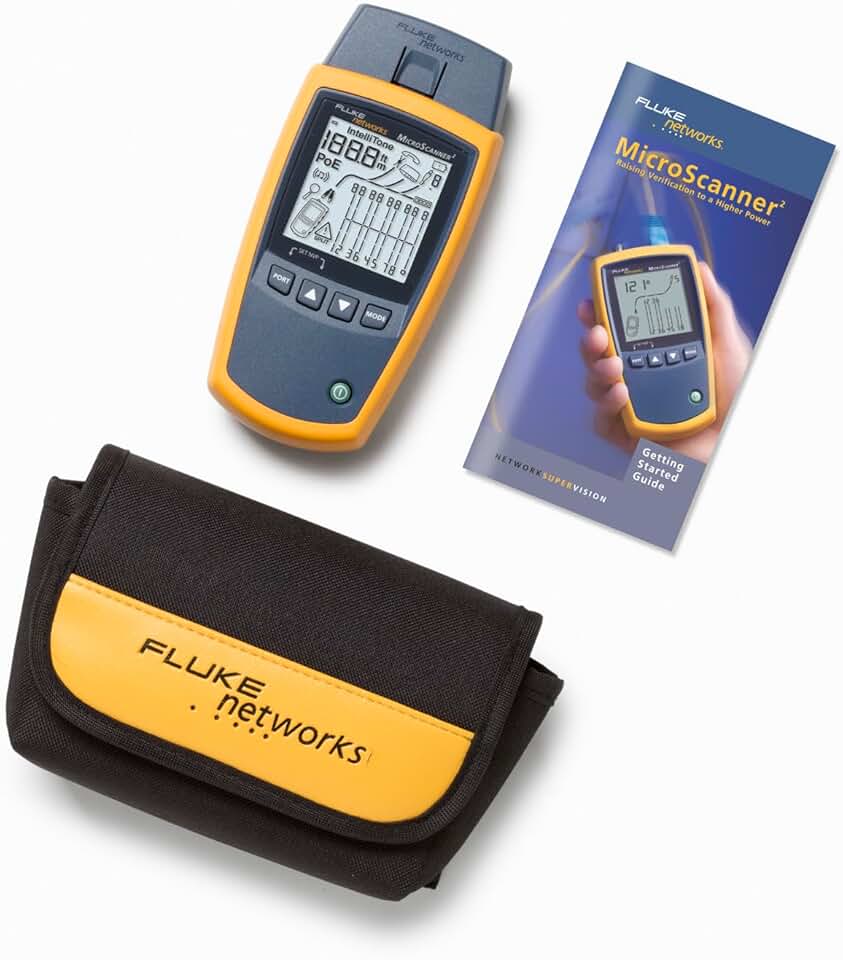
Fluke MicroScanner2: Ultimate Cable Verifier – Impressive
The Fluke MicroScanner2 copper cable verifier stands out as an indispensable tool for network technicians and IT professionals. It combines several essential testing functions into one robust, handheld device. This impressive unit streamlines the process of verifying and troubleshooting copper cabling, making complex tasks much simpler and faster.
Quick Summary: Fluke MicroScanner2
Rating: 4.4/5.0 (Based on 380+ reviews)
Price: Approximately $566.42 USD
Key Pros:
- All-in-One Verification: Combines multiple tests (wiremap, length, TDR, PoE, service detection) into a single, intuitive interface, significantly reducing the need for multiple tools and speeding up diagnostic time.
- Built-in IntelliTone Toning: Features both digital and analog toning to accurately locate and isolate cables in bundles, even in active network environments, preventing costly guesswork and rework.
- Robust and User-Friendly Design: Engineered for durability in field environments with a bright, backlit LCD that clearly displays all results, making it easy for technicians of all skill levels to operate effectively.
Key Cons:
- Premium Price Point: While offering extensive capabilities, its cost can be a significant investment for hobbyists or those with very infrequent, basic testing needs, potentially making it overkill for simple continuity checks.
- No Certification Capabilities: It is a verifier, not a certifier, meaning it cannot provide detailed pass/fail reports required for specific industry standards or warranty purposes, which limits its use in certain professional installations.
Table of Contents
Fluke MicroScanner2 Overview
The Fluke MicroScanner2 represents a significant leap forward in handheld cable verification technology. It’s designed to simplify the often-complex process of installing, maintaining, and troubleshooting copper Ethernet cabling. This device is not just a simple continuity tester; it’s a sophisticated tool that provides a comprehensive view of network infrastructure health.
For IT professionals and network technicians, time is always a critical factor. The MicroScanner2 addresses this by offering immediate, accurate results that reduce diagnostic time. Instead of cycling through multiple tools for different tests, this single unit provides a holistic assessment, from cable integrity to active network service detection.
One of its core functionalities is the ability to perform a complete wiremap test. This quickly identifies common wiring faults such as opens, shorts, cross-overs, and split pairs, which are frequent culprits behind network performance issues. The clear graphical display makes interpreting these results straightforward, even for less experienced users.
Beyond basic wiremapping, the MicroScanner2 also measures cable length using Time Domain Reflectometry (TDR) technology. Knowing the exact length of a cable run helps in identifying breaks or impedance mismatches, and it’s invaluable for efficient cable management and installation planning.
Furthermore, this device excels at identifying active network services. It can detect if a port is connected to a 10/100/1000Base-T Ethernet switch, identify Power over Ethernet (PoE) presence and voltage, and even detect plain old telephone service (POTS). This capability is crucial for quickly determining if a network issue lies with the cabling or the active equipment.
The robust construction of the Fluke MicroScanner2 ensures it can withstand the rigors of daily field use. Its durable casing protects against drops and impacts, making it a reliable companion for technicians working in various challenging environments, from data centers to industrial settings. The intuitive user interface, characterized by clear icons and a bright, backlit LCD, minimizes the learning curve and maximizes efficiency.
In essence, the MicroScanner2 empowers users to confidently verify that copper cabling infrastructure is installed correctly and functioning optimally. It helps prevent costly downtime by quickly pinpointing problems, thereby maintaining the smooth operation of essential network services. This makes it an invaluable asset for anyone responsible for network performance.
Whether you are setting up a new network, expanding an existing one, or diagnosing a connectivity issue, the MicroScanner2 offers the insights needed to make informed decisions. Its ability to consolidate multiple testing functions into one portable device makes it a go-to choice for streamlining workflow and enhancing productivity in network management tasks.
Understanding the full capabilities of a tool like the Fluke MicroScanner2 can significantly impact a technician’s efficiency. It transitions cable testing from a series of disjointed checks to a cohesive, integrated diagnostic process. This not only saves time but also reduces the potential for human error in complex network environments.
The device’s ability to detect different Ethernet speeds is particularly useful when upgrading network infrastructure. It helps confirm that newly installed cables can support the intended bandwidth, preventing bottlenecks before they become operational problems. This proactive approach to network health is a key benefit of integrating the MicroScanner2 into a regular testing regimen.
Fluke MicroScanner2 Key Features & Specs
The Fluke MicroScanner2 is packed with features designed to make cable verification and network troubleshooting as efficient as possible. Understanding these key functionalities is crucial for appreciating its value in a professional toolkit. Each feature addresses specific challenges faced by technicians daily.
All-in-One Cable Verification
This device supports multiple cable types, including RJ11, RJ45, and Coax, making it incredibly versatile. It can test telephone, Ethernet, and video cables, providing comprehensive diagnostics without needing separate testers for each type. This multi-functionality is a huge time-saver in diverse cabling environments.
The MicroScanner2 quickly performs continuity tests, ensuring that all conductors in a cable are intact. It also checks for proper wiring configurations, identifying common errors like crossed pairs or split pairs that can degrade network performance. This integrated approach simplifies the diagnostic process immensely.
IntelliTone Digital and Analog Toning
One of the standout features is Fluke’s patented IntelliTone technology. This allows the MicroScanner2 to digitally tone live networks, safely and effectively locating cables even when they are connected to active equipment. It minimizes false positives and provides precise cable identification.
For non-active networks or specific legacy systems, the MicroScanner2 also offers analog toning. This dual capability ensures maximum flexibility in cable tracing across various network setups. Using the included probe, technicians can quickly pinpoint the exact cable in a bundle, eliminating guesswork and speeding up installations or repairs.
Service Detection and PoE Capabilities
The MicroScanner2 can detect the presence of common network services on a port. It identifies if a port is connected to a 10/100/1000Base-T Ethernet switch, providing immediate feedback on active network connectivity. This helps in quickly determining if a port is live and at what speed.
Crucially, it also detects Power over Ethernet (PoE) and displays the voltage, confirming if power is being delivered to a device. This is invaluable for troubleshooting VoIP phones, wireless access points, and security cameras that rely on PoE. Knowing the PoE status instantly can save significant diagnostic time.
Cable Length Measurement and Distance to Fault
Utilizing Time Domain Reflectometry (TDR), the MicroScanner2 accurately measures the length of a cable run. This feature is critical for ensuring cables meet specification and for identifying the physical location of a fault. If there’s an open or a short, the device can tell you exactly how far down the cable the problem lies.
This precision helps technicians avoid pulling new cables unnecessarily or spending hours searching for a break in a wall. By providing a clear distance to fault, it enables targeted repairs, saving both time and material costs. The accuracy of TDR measurements is a core strength of this device.
Robust Display and User Interface
The large, backlit LCD screen on the MicroScanner2 ensures readability in all lighting conditions, from dimly lit wiring closets to bright outdoor environments. The intuitive graphical interface displays all test results simultaneously, making it easy to understand the cable’s condition at a glance.
Icons and clear text messages guide the user through testing and troubleshooting processes. This user-friendly design minimizes the need for extensive training, allowing technicians to quickly become proficient with the tool. The simplicity of the interface belies the complex diagnostic power within the device.
Rugged, Field-Ready Design
Durability is paramount for tools used in demanding field environments. The MicroScanner2 features a robust, ergonomic design with a protective rubber overmold. This construction makes it resistant to drops, impacts, and general wear and tear, ensuring a long operational life.
Its compact size and lightweight nature also contribute to its portability, allowing technicians to carry it easily from job site to job site. The combination of durability and portability makes it an ideal tool for professionals constantly on the move, facing diverse physical challenges.
Port Identification and Blinking Lights
When connected to a network switch, the MicroScanner2 can blink the port light on the switch. This feature helps in quickly identifying which port a specific cable is connected to, even in a crowded patch panel. It eliminates the need for manual tracing and potential errors, streamlining switch management.
This simple yet effective function significantly reduces the time spent on cross-referencing documentation or physically following cables. It’s particularly useful in large installations where patch panels can be complex and confusing, enhancing overall operational efficiency.
Pros & Cons
Evaluating any tool requires a balanced look at its strengths and weaknesses. The Fluke MicroScanner2, while highly capable, presents its own set of advantages and limitations that prospective buyers should consider. Understanding these aspects helps in making an informed decision about its suitability for specific tasks.
Key Pros of the Fluke MicroScanner2
- Comprehensive Diagnostics from a Single Device: The MicroScanner2 excels by integrating multiple testing functionalities into one compact unit. It can perform wiremap, length measurement, distance-to-fault, PoE detection, and active service identification simultaneously. This saves technicians considerable time by eliminating the need to switch between different tools for various tests, streamlining the diagnostic workflow significantly.
- Exceptional Ease of Use and Intuitive Interface: Its user-friendly design, featuring a large, backlit LCD and clear graphical icons, makes it accessible even for less experienced users. The device presents all critical test results on a single screen, allowing for quick interpretation of cable and network status. This reduces the learning curve and speeds up troubleshooting.
- Time-Saving in Troubleshooting and Installation: By quickly identifying cable faults, network service issues, and cable locations with IntelliTone technology, the MicroScanner2 drastically cuts down on diagnostic time. This efficiency translates directly into reduced labor costs and minimized network downtime, proving its worth in busy professional environments.
- Robust and Durable Construction: Built to withstand the rigors of field use, the MicroScanner2 features a rugged casing and protective rubber overmold. This durability ensures a long operational life, even in challenging work environments like construction sites, data centers, or industrial settings, protecting the investment.
- Accurate Cable Length and Distance to Fault Measurements: The integrated Time Domain Reflectometry (TDR) technology provides precise measurements of cable length and accurately pinpoints the location of faults like opens or shorts. This precision allows for targeted repairs, preventing the need for extensive cable replacement or exploratory work, further enhancing efficiency.
- Versatility Across Multiple Cable and Service Types: Supporting RJ11, RJ45, and Coax cables, along with detecting 10/100/1000Base-T Ethernet, POTS, and PoE, makes the MicroScanner2 highly adaptable. It’s a versatile tool for various network infrastructures, from traditional telephony to modern Ethernet and surveillance systems, reducing the need for specialized testers.
Key Cons of the Fluke MicroScanner2
- Premium Price Point: The advanced capabilities and Fluke’s reputation for quality come with a higher price tag compared to basic cable testers. For individuals or small businesses with very limited budgets or only occasional, simple testing needs, this investment might seem substantial. However, its value is often justified by its comprehensive features and reliability.
- Not a Full Cable Certifier: While it is an excellent verifier, the MicroScanner2 does not perform full cable certification. Certification requires more extensive testing to industry standards (e.g., TIA/ISO) and generates detailed pass/fail reports, often necessary for network warranties or client handover. For certification tasks, a higher-end Fluke Networks product would be required.
- Limited Advanced Network Diagnostics: While it detects active services, the MicroScanner2 doesn’t offer deeper network diagnostics like packet capture, advanced traffic analysis, or detailed network mapping. Its focus is primarily on the physical layer and basic service detection, meaning more complex network issues might require additional, specialized tools.
- Battery Life Under Heavy Use: Like many portable electronic devices, intensive use of features like toning and backlighting can drain batteries relatively quickly. While it uses standard AA batteries, carrying spares or planning for recharges is advisable for extended field operations. This is a common consideration for most handheld testing equipment.
- Potential Overkill for Basic Users: For someone who only needs to perform very simple continuity checks or occasional wiremap tests on a home network, the extensive feature set of the MicroScanner2 might be more than what’s truly necessary. Simpler, more affordable testers exist for such basic requirements, making this device potentially over-specified for casual users.
Overall, the Fluke MicroScanner2 presents a compelling package for professionals, offering significant advantages in efficiency and diagnostic capability. Its limitations are generally related to its specific role as a verifier rather than a certifier or a full network analyzer, reflecting its intended market segment.
Who Should Buy the Fluke MicroScanner2?
The Fluke MicroScanner2 is a specialized tool, and its value is most apparent to certain professional groups. While its capabilities are impressive, it’s not designed for every user. Understanding who benefits most from its features helps potential buyers determine if this investment aligns with their needs and responsibilities.
Network Technicians and IT Professionals
This is arguably the primary target audience for the MicroScanner2. Network technicians are constantly installing, maintaining, and troubleshooting copper cabling infrastructure. The device’s ability to quickly verify wiremap, length, and active services like PoE makes it an indispensable daily tool for these professionals.
IT professionals responsible for network uptime and performance will find the MicroScanner2 invaluable for rapid diagnostics. When a user reports a connectivity issue, this tool can quickly ascertain if the problem lies with the physical cable, the network port, or a lack of power from PoE. This rapid fault isolation saves significant time and reduces user frustration.
Electricians and Low-Voltage Installers
Electricians who frequently install data cabling alongside electrical wiring can greatly benefit from the MicroScanner2. It allows them to verify their work immediately after installation, ensuring that data lines are correctly terminated and free of faults before walls are closed or systems are handed over. This proactive testing prevents costly rework.
Low-voltage installers working with security cameras, access control systems, or audio-visual setups often deal with various copper cable types, including Ethernet and coaxial. The MicroScanner2’s multi-cable support and toning capabilities make it perfect for verifying these diverse installations and tracing cables in complex environments.
System Integrators and Network Contractors
For businesses that design and implement network solutions for clients, the MicroScanner2 is an essential tool for quality assurance. It allows integrators to verify the integrity of their installations before deployment, minimizing post-installation support calls and enhancing client satisfaction. Its robust nature is also suited for project-based work.
Network contractors who undertake large-scale cabling projects will find the MicroScanner2’s speed and accuracy critical for project efficiency. It helps manage multiple cable runs, identify and rectify issues quickly, and ensure that all installed infrastructure meets basic performance requirements.
Small to Medium Business (SMB) Owners/IT Staff
SMBs that manage their own internal networks often have limited IT resources. The MicroScanner2 empowers general IT staff to perform professional-grade cable diagnostics without requiring extensive specialized training. It’s a cost-effective way to maintain network reliability without hiring external specialists for every minor issue.
For an SMB, network downtime can be catastrophic. Having a tool like the MicroScanner2 on hand allows for quick problem resolution, ensuring business continuity. It provides a level of self-sufficiency that is highly valuable for organizations with constrained budgets.
While the MicroScanner2 is powerful, it might be overkill for a casual home user who only occasionally checks a single Ethernet cable. For those specific, infrequent, and very basic needs, a much simpler and less expensive continuity tester might suffice. However, for anyone managing a more complex home network with multiple runs, or for tech-savvy enthusiasts, the MicroScanner2 offers unparalleled insight.
Consider your frequency of use, the complexity of your cabling infrastructure, and the criticality of network uptime. If you regularly deal with network installations, troubleshooting, or maintenance, the investment in a Fluke MicroScanner2 will quickly pay for itself through saved time and increased efficiency. It’s built for those who need reliable, fast answers about their copper cabling.
The device’s comprehensive feature set means fewer tools to carry and manage. This consolidation of capabilities into one ergonomic unit is a major draw for professionals who prioritize efficiency and portability in their daily work. It bridges the gap between basic testers and expensive certifiers, offering a sweet spot of functionality and cost-effectiveness for verification tasks.
For professionals who need to quickly isolate problems in a live network environment, the IntelliTone feature alone can be a game-changer. It allows for non-disruptive cable tracing, which is critical in production environments where taking down a network segment is not an option. This capability alone justifies the investment for many.
Ultimately, if your role involves ensuring the reliability and performance of copper-based network infrastructure, and you value efficiency, accuracy, and durability in your tools, the Fluke MicroScanner2 is an excellent candidate for your toolkit. It’s an investment in productivity and problem-solving capability that delivers tangible returns.
Before making a purchase, consider the specific requirements of your projects and the types of issues you most frequently encounter. If you find yourself consistently needing to identify cable faults, verify network services, or trace cables, then the MicroScanner2 is designed precisely for those scenarios, offering a robust and reliable solution.
FAQ about Fluke MicroScanner2
Here are some frequently asked questions about the Fluke MicroScanner2 copper cable verifier, providing more detailed insights into its functionality and applications.
Q1: What types of cables can the Fluke MicroScanner2 test?
The Fluke MicroScanner2 is highly versatile, designed to test a wide range of copper cabling types. It supports RJ11 (for telephony), RJ45 (for Ethernet), and Coax (for video or internet). This comprehensive support means you can use one tool for various communication and network infrastructure checks.
This multi-format capability is particularly beneficial for technicians working in environments with mixed cabling systems, eliminating the need to carry separate testers for different cable types. It streamlines the diagnostic process across diverse installations, from office networks to residential setups.
Q2: What is IntelliTone toning used for?
IntelliTone toning is a patented technology developed by Fluke Networks designed for precise cable location. It generates a digital signal that can be detected by an IntelliTone probe, allowing technicians to quickly and accurately trace cables in bundles, through walls, or within patch panels. It effectively cuts through cable noise and interference.
Unlike traditional analog toners, IntelliTone can even trace cables connected to active network equipment without causing disruption. This feature is invaluable for identifying specific cables in crowded wiring closets, saving significant time and reducing the risk of disconnecting the wrong cable.
Q3: Does the Fluke MicroScanner2 test for Power over Ethernet (PoE)?
Yes, the MicroScanner2 can detect and display Power over Ethernet (PoE) presence and voltage. This is a crucial feature for troubleshooting devices like VoIP phones, wireless access points, and IP cameras that draw power directly from the Ethernet cable. It quickly confirms if a port is delivering the expected power.
The device also identifies the PoE class, providing further detail about the power capabilities of the network port. This helps in diagnosing issues where PoE devices are not powering up correctly, distinguishing between a cable fault, a port issue, or a device problem.
Q4: Is the MicroScanner2 a cable certifier?
No, the Fluke MicroScanner2 is a cable verifier, not a certifier. A verifier confirms that a cable is connected correctly and identifies basic faults, and detects active services. A certifier, on the other hand, performs extensive tests against industry standards (like TIA/ISO) to provide detailed pass/fail reports, often required for network warranties and high-performance installations.
While the MicroScanner2 provides valuable insights into cable integrity and network services, it does not generate the comprehensive documentation or guarantee the performance levels that a full certifier would. It’s best suited for troubleshooting, installation verification, and basic performance checks rather than formal certification.
Q5: How durable is the Fluke MicroScanner2 for field use?
The MicroScanner2 is built with a rugged, field-ready design to withstand demanding work environments. It features a robust casing and a protective rubber overmold that guards against drops, impacts, and general wear and tear. This construction ensures its longevity and reliability even in harsh conditions.
Its durable design makes it a trusted tool for technicians who work in various challenging settings, from dusty construction sites to busy data centers. The emphasis on robust construction reflects Fluke’s commitment to producing reliable tools that perform consistently in the real world. You can learn more about Fluke Networks’ product philosophy on their official website.
Q6: Can the MicroScanner2 identify switch port information?
Yes, the MicroScanner2 has a useful feature that allows it to identify switch port information. When connected to an active network port, it can display information such as the port speed (10/100/1000Base-T) and duplex settings. This helps in understanding the network connectivity at the physical layer.
Additionally, it can cause the switch port light to blink, making it easy to visually identify which physical port a cable is connected to on a crowded switch or patch panel. This eliminates manual tracing and speeds up network documentation and troubleshooting tasks significantly.
Q7: What kind of battery does the Fluke MicroScanner2 use and what’s the typical battery life?
The Fluke MicroScanner2 typically uses two AA alkaline batteries. The battery life can vary significantly depending on usage patterns, especially how often features like backlighting and IntelliTone toning are used. Under normal, intermittent use, a set of batteries can last for several hours of active testing.
For intensive, prolonged use, it’s always advisable for technicians to carry spare AA batteries. The device also has a low battery indicator to alert users when replacement is needed, ensuring you’re not caught off guard during critical tasks. This makes it convenient for field work without proprietary charging systems.
Q8: Does it provide any network performance metrics?
While the Fluke MicroScanner2 primarily focuses on physical layer verification, it does offer some basic insights into network performance by detecting Ethernet link speed (10/100/1000Base-T). It confirms if the cable and port are capable of supporting the advertised speeds. However, it does not provide advanced performance metrics like bandwidth utilization, latency, or packet loss.
For deeper network performance analysis, you would typically need a more advanced network analyzer tool. The MicroScanner2’s role is to ensure the cabling foundation is sound, and the basic services are present and correct, providing the essential groundwork for reliable network operation. For more on Ethernet cables, refer to the Wikipedia page on Ethernet cables.
Final Verdict
The Fluke MicroScanner2 copper cable verifier stands as an outstanding investment for any professional involved in network installation, maintenance, or troubleshooting. Its ability to consolidate multiple critical tests into a single, intuitive device significantly enhances efficiency and accuracy in the field. This tool truly delivers on its promise of simplifying complex cabling diagnostics.
From comprehensive wiremap testing and precise cable length measurements to intelligent toning and active service detection, the MicroScanner2 provides a holistic view of your copper infrastructure. Its robust construction ensures durability in challenging environments, making it a reliable companion for years to come. The user-friendly interface means less time spent on learning and more time spent on solving problems.
While its premium price might be a consideration for some, the time saved and the confidence gained from its accurate diagnostics quickly justify the investment for professionals. It bridges the gap between basic continuity testers and expensive certification tools, offering the perfect balance of functionality and cost-effectiveness for verification tasks. It’s an indispensable asset for network technicians, IT staff, electricians, and system integrators.
The Fluke MicroScanner2 empowers users to identify and resolve cable-related issues swiftly, minimizing network downtime and maximizing productivity. Its ability to detect Power over Ethernet and identify switch port information further solidifies its position as a versatile and essential tool. This comprehensive functionality makes it a standout product in its category.
In conclusion, if you are seeking a reliable, efficient, and user-friendly solution for verifying and troubleshooting copper cabling and network services, the Fluke MicroScanner2 is an impressive choice. It’s a tool that pays for itself by preventing costly errors and accelerating problem resolution. This device truly elevates the standard for handheld cable verification.